Tarot Court Cards: A Practical Guide
Learn a flexible way to read Pages, Knights, Queens, and Kings as people, roles, attitudes, or ways of acting in a tarot spread.
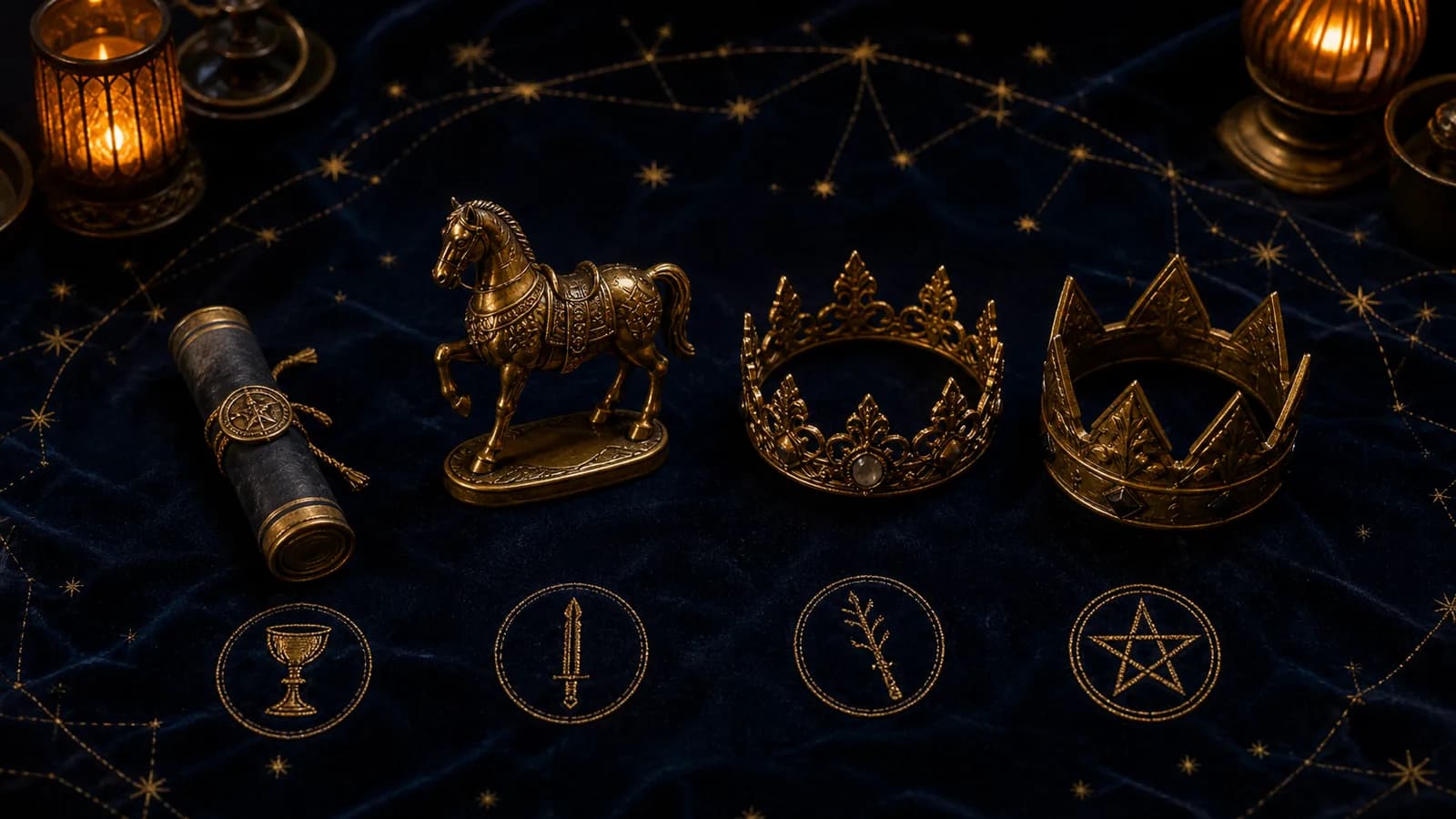
Court cards are often the point where a clear tarot reading turns uncertain. Does the Queen of Swords represent you, another person, or a direct conversation? Is the Knight of Cups a romantic visitor, an invitation, or your own impulse to follow a feeling?
The difficulty comes from asking a court card to have only one job. A Page, Knight, Queen, or King can describe a person, but it can also show a role, an attitude, a social dynamic, or the way an element needs to be expressed. The question and card position help you decide which layer is useful.
The Sixteen Court Cards
The Minor Arcana contains four court ranks in each of its four suits:
- Pages: Page of Cups, Swords, Wands, and Pentacles
- Knights: Knight of Cups, Swords, Wands, and Pentacles
- Queens: Queen of Cups, Swords, Wands, and Pentacles
- Kings: King of Cups, Swords, Wands, and Pentacles
That makes sixteen court cards altogether. Some decks rename them. A Page may become a Princess, Daughter, or Knave; a Knight may become a Prince; and a King or Queen may carry a different title. Read the guide for your deck, but do not let the name hide the structure: rank describes a mode of expression, while suit describes the field in which it operates.
Our Minor Arcana guide explains the four fields in detail. Cups bring attention to feeling and connection, Swords to thought and communication, Wands to desire and action, and Pentacles to body, work, time, and material resources.
Page: Learning And First Contact
Pages meet the suit with curiosity. They can show a beginner, a message, an invitation to study, or an early encounter with an experience. A Page does not need to be a child. It may describe the part of any person that is observing, experimenting, or willing to admit, “I do not know yet.”
The Page of Swords might be researching, asking sharp questions, or watching before speaking. The Page of Cups may be learning how to name a feeling or receiving a gentle emotional invitation. The Page of Pentacles often asks for a practical first step, while the Page of Wands explores a fresh enthusiasm.
When a Page appears, ask:
- What am I ready to learn?
- What message or small opening deserves attention?
- Where would curiosity be more useful than certainty?
Knight: Pursuit And Movement
Knights put the suit into motion. They pursue, test, defend, deliver, and sometimes rush. Their strength is commitment to movement; their risk is becoming so identified with one direction that they lose perspective.
The Knight of Swords may move through argument, analysis, or decisive speech. The Knight of Cups follows feeling, beauty, or an ideal. The Knight of Wands seeks experience and momentum. The Knight of Pentacles advances through repetition, reliability, and patient effort.
Instead of asking only, “Who is arriving?” ask, “What is being pursued, and how?” A Knight in an advice position may describe the pace you need. In an obstacle position, the same Knight may show haste, avoidance, fixation, or movement without reflection.
Queen: Embodied Understanding
Queens often represent an inward, relational, or sustaining command of the suit. They understand an energy well enough to hold it, protect it, and respond with discernment. “Inward” does not mean passive. It means authority that begins with awareness and embodiment.
The Queen of Cups can hold emotional complexity without becoming every feeling in the room. The Queen of Swords can listen carefully and still name a boundary. The Queen of Wands sustains creative confidence and social warmth. The Queen of Pentacles knows what care requires in time, money, labor, and physical reality.
A Queen can ask:
- What quality needs to be held steadily?
- What boundary protects what matters?
- How can I respond from experience rather than reaction?
King: Direction And Responsibility
Kings often direct the suit outward. They organize, decide, take responsibility, and shape conditions beyond themselves. A King may indicate leadership, but leadership is not automatically healthy. Authority can become control, emotional distance, rigidity, or overconfidence when it stops listening.
The King of Cups may guide a difficult emotional conversation without being swept away. The King of Swords may establish a policy or make a reasoned decision. The King of Wands directs vision into coordinated action. The King of Pentacles builds systems that can endure.
In a reading, ask whether this form of authority is mature, missing, excessive, or being projected onto someone else.
Court Cards Are Not Fixed Genders Or Ages
Older guidebooks sometimes describe court cards through narrow categories of age, appearance, and gender. You do not need those categories to read them well. A Queen can describe a man using receptive authority; a King can describe a woman directing a team; a Page can describe an experienced person beginning again in a new field.
Gender may matter when it is meaningful to the question or imagery, but it should not become a shortcut that overrides evidence. Begin with behavior: What is the figure doing? How is the suit moving through that behavior? Only then ask whether a person in the situation fits the pattern.
A Three-Lens Method For Any Court Card
When a court card appears, test three lenses in order.
1. Role
First ask what role the card describes. Is someone learning, pursuing, sustaining, or directing? This is usually more useful than guessing a person immediately.
2. Expression
Combine rank and suit. A Knight pursues; Cups indicates feeling and connection. The Knight of Cups may therefore describe pursuing an emotional ideal, delivering an invitation, or moving according to feeling. Keep the sentence broad until the question narrows it.
3. Identity
Finally ask whether the pattern belongs to you, another person, or the dynamic between people. Use the spread position and observable behavior. If you cannot identify a person responsibly, keep the card as a role or mode of action.
This order prevents the reading from turning into unsupported claims about somebody’s private mind. Our guide to better tarot questions can help keep relationship readings focused on what you can observe and choose.
Example: The Same Queen In Two Questions
Imagine drawing the Queen of Swords in a career spread, in the position “resource available to me.” The role is steady discernment; the suit is thought and communication. The card might describe your ability to define criteria, ask direct questions, or negotiate a boundary. It does not require a literal woman to enter the situation.
Now imagine the same card in a relationship spread, in the position “conversation needed.” Her clarity may point toward naming what is true without using cruelty as proof of honesty. The underlying quality is similar, but the position changes how it becomes useful.
This is why card meaning cannot be separated from question and position. A flexible method is not vague when each step is anchored in context.
When Several Court Cards Appear
Two or more court cards often highlight roles, social dynamics, or different strategies for handling the same issue. Before assigning each card to a person, compare them:
- Are the ranks equal, or is one learning while another directs?
- Do the suits cooperate or create tension?
- Are the figures facing one another or turning away?
- Which card appears in the self, environment, obstacle, or advice position?
The Page of Pentacles beside the King of Pentacles could show development from learning to mastery. It could also show a student and mentor, a new plan meeting an established system, or one person alternating between curiosity and control. Read the structure before choosing the story. The companion guide to tarot card combinations develops this process further.
Reversed Court Cards
A reversed court card does not automatically describe a bad person. Start with the upright mode and ask whether it is blocked, delayed, excessive, internalized, or poorly matched to the situation.
A reversed Knight of Wands may show movement without direction, energy held back, or enthusiasm that repeatedly burns out. A reversed Queen of Cups may suggest emotional awareness becoming overwhelm or care that lacks boundaries. A reversed King of Swords might point to rigid reasoning, avoided responsibility, or authority used without enough humanity.
Keep the interpretation attached to behavior rather than character judgment. For a fuller reversal method, see How To Read Reversed Cards.
A Practice That Builds Confidence
Separate the sixteen court cards from your deck and arrange them in a four-by-four grid. Compare one rank across all suits, then one suit across all ranks.
Write one verb for every card. For example, Pages might learn, notice, ask, or receive; Knights pursue, carry, test, or move; Queens hold, understand, sustain, or protect; Kings direct, decide, organize, or take responsibility. Then add the suit field.
Finally, draw one court card and place it in four positions: “my current role,” “a resource,” “an obstacle,” and “a next step.” Notice how the same structure changes with the job it receives. This exercise teaches flexibility without abandoning consistency.
Quick FAQ
Does a court card always represent a real person?
No. It may represent a person, but it can also describe a role, attitude, developmental stage, social dynamic, message, or way of acting.
Do Queens always mean women and Kings always mean men?
No. Read rank as a mode of expression before treating it as gender. Use identity only when the question and observable context support it.
What if I cannot tell who the court card is?
Keep it as a role. Translate rank plus suit into a behavior, then use the card position to decide how that behavior functions in the reading.