How To Choose A Tarot Spread: From One Card To Three
Different spreads fit different questions. Learn when to use one-card readings, three-card spreads, and small expanded layouts.
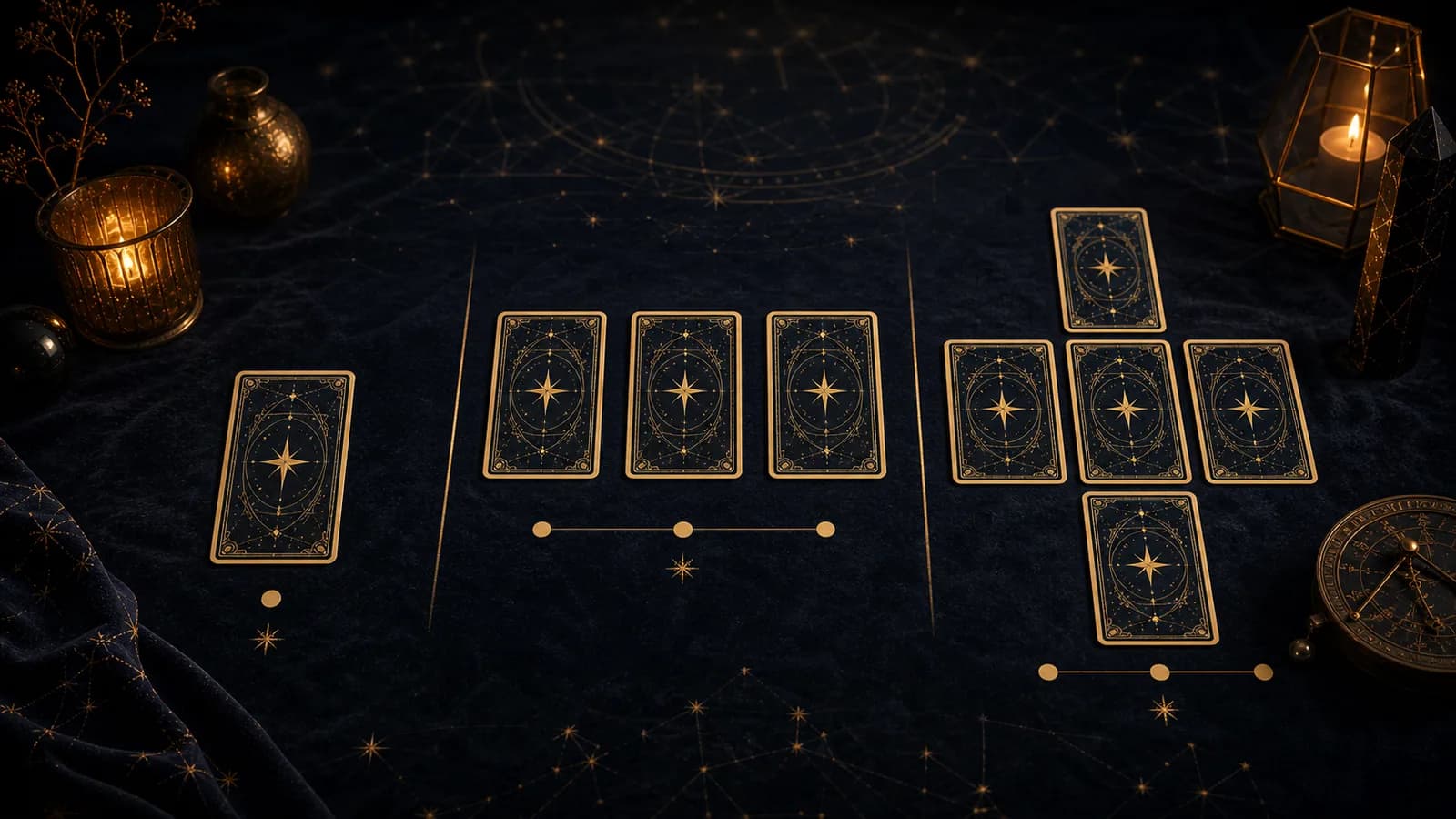
A tarot spread is the map of a reading. It decides where your attention goes and how one card speaks to another. You do not need a large layout to create a meaningful reading. In the beginning, simple structures are often the most revealing.
One Card: A Clear Reminder
A one-card reading is perfect for daily reflection, emotional calibration, or finding the central theme inside a complicated situation. It is not less meaningful. It simply asks you to focus.
Useful questions include: “What should I pay attention to today?” “What is the core energy of this situation?” “What do I need to notice before I act?”

Three Cards: A Reliable Foundation
Three-card spreads add structure without becoming overwhelming. Common patterns include “past, present, future,” “cause, situation, advice,” or “me, them, the relationship.”
When reading three cards, do not interpret them only one by one. Notice the atmosphere of the whole line. Are the cards moving in the same direction? Which card feels strongest? Which one looks like the turning point?
Small Expanded Spreads
If your question is already specific, a four- or five-card spread can help. For example: “current situation, obstacle, hidden resource, advice, possible development.” This works well for relationships, career choices, and long-term plans.
Each card position should have a clear job. If two positions ask the same thing, the reading becomes noisy.
A Simple Rule
The more unclear the question, the simpler the spread should be. The more precise the question, the more room you have to expand. A good spread does not make the reading heavier. It makes the situation easier to see.
A Spread Is A Question Structure
A spread is not more advanced just because it has more cards. It is a way of dividing a question into useful angles. The V&A’s history of tarot reminds us that tarot itself has moved through card play, visual culture, and divinatory use; modern spreads are practical reading methods, not unchangeable ancient laws.
You can design your own spread if each position is clear, distinct, and useful.
Three Useful Three-Card Spreads
The first is “past, present, future.” It is helpful for seeing development, but the future card should not be treated as fixed fate. A more grounded reading is: “If the current pattern continues, what direction may emerge?”
The second is “situation, obstacle, advice.” This is excellent when you feel stuck because the third card directly points toward action.
The third is “me, them, the relationship.” This can be useful for relationship questions, but do not read “them” as total access to another person’s private mind. Read it as the energy or observable pattern connected with the other person in the relationship.
Learn The Celtic Cross Slowly
Waite’s Pictorial Key to the Tarot presents the well-known Celtic Cross method, including positions for the present situation, crossing influence, foundation, past, possible outcome, near future, self, environment, hopes or fears, and final result. It is rich, but it can overwhelm beginners.
If you use the Celtic Cross too early, each card may receive only shallow attention. Become comfortable with three-card readings first, then expand.
Designing Your Own Spread
Write the question first, then name the angles you actually need. For a career decision, try: “current situation, true value, practical obstacle, available resource, next step.” For a relationship issue, try: “my feeling, repeated pattern, boundary to express, advice.”
The more specific the position, the clearer the answer. Avoid vague positions like “future one, future two, future three.”
Integrating The Spread
After reading each card, step back. What do the cards say together? Which card feels central? Which one gives advice? Do any cards contradict each other? Contradiction is useful; it may reveal an inner conflict.
A good spread should eventually become one or two clear sentences.
How To Choose The Right Number Of Cards
Use one card when you need a focus. Use three cards when you need contrast. Use five cards when the question has several real parts. Use larger spreads only when you have enough time and emotional steadiness to interpret them well.
More cards are not automatically more accurate. A ten-card spread can become vague if the question is vague. A one-card reading can be precise if the question is clean. If you are unsure, begin small and add one clarifying card only after you have interpreted the original spread.
For question design, pair this article with How To Ask Better Tarot Questions.
Example Spreads For Common Situations
For decision-making, try: option A, option B, what matters most. This does not force a final verdict, but it shows the texture of each path.
For creative work, try: current strength, hidden block, next experiment. This keeps the reading active and prevents it from becoming abstract encouragement.
For emotional processing, try: feeling, need, kind next step. This is especially helpful when the goal is self-understanding rather than prediction.
For relationship reflection, try: my experience, the pattern between us, the boundary or conversation needed. Avoid using a spread as if it grants total access to another person’s private thoughts. A spread should clarify responsibility, not bypass it.
For work-specific layouts, use the career tarot spreads for offers, changes, and comparisons. They preserve this same structure while adding practical research, criteria, and review steps.
Clarifying Cards Without Overloading The Reading
Clarifying cards are useful when a card is genuinely ambiguous, but they can become a way to avoid interpretation. Before drawing a clarifier, say exactly what you need clarified. “What does this obstacle card need me to understand?” is better than drawing another card because you feel uneasy.
Use one clarifier at a time. If every card receives another card, the spread loses shape. Often the better move is to return to the image, the question, and the card position.
Reading The Shape Of A Spread
After interpreting individual cards, scan the whole layout. Are there many Major Arcana cards? The issue may involve a larger life theme. Are there many Swords? Thought, conflict, language, or judgment may dominate. Are there no Cups in a relationship reading? Emotion may be avoided or expressed indirectly.
Look at direction too. Figures facing each other may suggest dialogue or tension. Figures facing away may suggest avoidance, independence, or different priorities. These visual patterns connect spread work with common tarot symbols.
When several of these signals appear together, use the guide to reading patterns across a tarot spread to rank repeated suits, numbers, court cards, Major Arcana, reversals, and missing elements without overloading the reading.
A Complete Three-Card Example
Suppose the question is, “What do I need to understand before deciding whether to continue this project?” The spread is situation, obstacle, advice. You draw The Star, Seven of Cups, and Knight of Pentacles.
The Star suggests the project still has meaning and long-term direction. Seven of Cups as the obstacle suggests too many fantasies, options, or imagined outcomes competing for attention. Knight of Pentacles as advice points toward patient, concrete work. The reading is not simply “continue” or “quit.” A better summary is: “The vision is still alive, but it needs fewer fantasies and a steadier plan.”
The action might be to choose one milestone, define the next practical task, and ignore the rest for a week. This is what a good spread does: it turns a large question into a usable sequence of insight.
For a longer walkthrough that includes question design, position statements, synthesis, an action plan, and review notes, read the complete three-card tarot reading example.
Common Spread Mistakes
The first mistake is giving every position a vague name, such as “future” or “energy,” without saying what kind of future or energy you mean. The second is asking several questions inside one position. The third is adding clarifier after clarifier until the original spread disappears.
A cleaner method is to write the spread positions before shuffling and keep them visible while interpreting. If a card feels confusing, return to its position. A difficult card in an advice position is different from the same card in an obstacle position. The map gives the card its job.
Quick FAQ
What is the best tarot spread for beginners?
The best beginner spread is usually three cards: situation, obstacle, advice. It is structured enough to be useful and small enough to read deeply.
Should I always use the Celtic Cross?
No. The Celtic Cross is rich, but it is not required. It works best when you have time, a clear question, and enough experience to synthesize many positions.
Can I invent my own spread?
Yes. A good custom spread has clear positions, no duplicate questions, and a final card that helps translate the reading into action.