How To Read Patterns In A Tarot Spread
Learn how repeated suits, numbers, court cards, Major Arcana, reversals, direction, and missing elements shape a tarot spread.
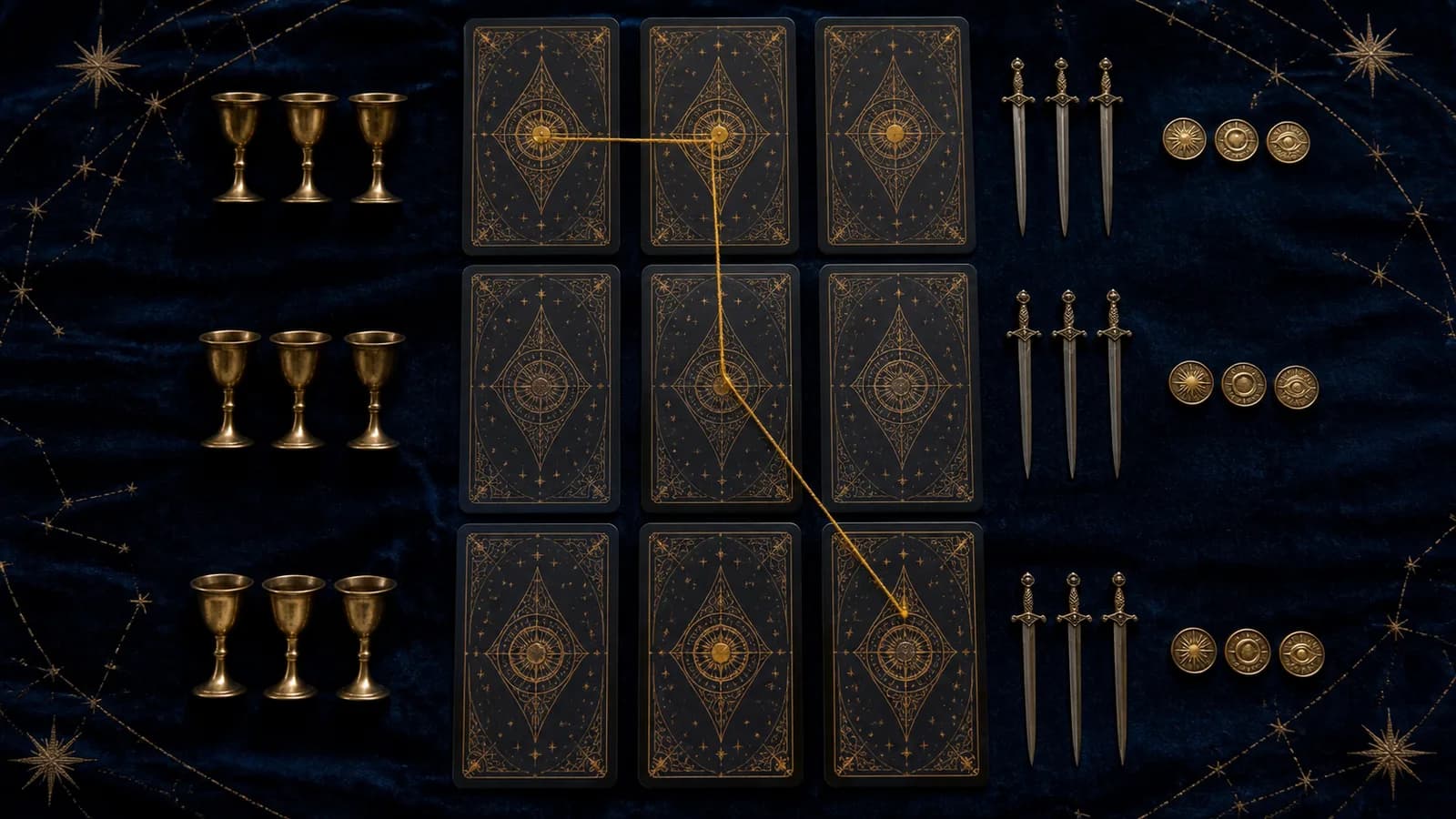
After interpreting every card in a spread, take one step back. The layout may contain a second layer that no single card can show: one suit dominates, the same number repeats, several court cards appear, Major Arcana cluster around one position, or every figure seems to move in the same direction.
These patterns help you decide where the reading’s weight sits. They do not create a secret code or override the question. The most reliable method is to read the individual positions first, scan the whole spread second, and include only patterns that make the final summary clearer.
Use A Two-Pass Reading
First Pass: Positions
Interpret each card according to its assigned job. Write one short position statement, such as “the obstacle is unclear communication” or “the available resource is patient practice.”
This prevents a dramatic visual pattern from taking over too early. Three Major Arcana cards may look important, but a card in the advice position still needs to offer advice.
Second Pass: The Whole Shape
Now scan for:
- Dominant or absent suits
- Repeated numbers or ranks
- Major and Minor Arcana balance
- Several court cards
- A cluster of reversals
- Visual movement and figure direction
- Progression, interruption, or contrast
Choose the strongest one or two patterns. If a pattern does not change the summary or next question, leave it out.
For the mechanics of connecting two or three specific cards, begin with How To Read Tarot Card Combinations. This guide focuses on the spread as a complete field.
A Dominant Suit
When one suit appears several times, it often identifies the field carrying most of the tension or activity.
Many Cups
The reading may emphasize emotion, connection, imagination, receptivity, or boundaries around care. This does not guarantee romance or happiness. Cups can also show emotional saturation, idealization, grief, or difficulty separating one person’s feelings from another’s.
Many Swords
Thought, language, decisions, rules, conflict, or judgment may dominate. A Swords-heavy spread can show clarity and honest analysis, but it can also reveal mental repetition, argument, or an attempt to solve every feeling through thought.
Many Wands
Action, desire, creativity, ambition, competition, or pace may be central. The spread may contain real momentum or too many initiatives competing for the same energy.
Many Pentacles
The issue may be grounded in work, money, time, body, home, skill, maintenance, or other material conditions. Pentacles can bring stability, but they may also reveal slowness, over-control, or a situation sustained only because it is familiar.
Always return to position. Four Swords cards in a communication spread mean something different from four Swords cards in a rest-and-recovery spread.
A Missing Suit
An absent suit is a prompt, not proof that something is wrong. In a relationship spread with no Cups, ask whether emotion is being expressed indirectly, avoided, or simply not central to the present question. In a career plan with no Pentacles, ask whether the reading has enough attention to time, resources, and practical conditions.
Other useful questions:
- No Swords: What has not been named, compared, or decided?
- No Wands: Where is desire, initiative, or energy missing?
- No Cups: Which feeling or relationship factor needs acknowledgment?
- No Pentacles: What practical support or embodied reality needs checking?
Sometimes nothing is missing. A three-card spread will naturally omit at least one suit. Treat absence as useful only when it matches the question and adds a better line of inquiry.
Repeated Numbers
Repeated numbers connect different suits through a shared stage. Two Fours may emphasize structure, stability, protection, or containment. Two Fives may show disruption and adjustment in more than one area. Two Eights may connect repetition, movement, skill, or restriction.
Check four things:
- Which positions contain the repeated number?
- How do the suits change the shared stage?
- Do the images reinforce the connection?
- Does the repetition describe a problem, a resource, or development?
A Four of Swords in a resource position and Four of Pentacles in an obstacle position might say that deliberate rest helps, while gripping resources too tightly blocks movement. The number does not make their meanings identical.
The tarot numerology guide explains Ace through Ten as a flexible developing cycle.
A Sequence Of Numbers
Numbers can also show movement. Two, Three, and Four may suggest a process building structure. Seven, Eight, and Nine may show a test becoming repeated effort and then intensity. A descending sequence may suggest simplification, returning to foundations, or losing momentum.
Do not assume every sequence predicts chronological events. Check whether the spread positions already create time or development. In a past-present-future layout, progression has a clear job. In a comparison layout, the same numbers may simply distinguish two options.
Many Major Arcana Cards
A spread with several Major Arcana cards may widen the issue toward identity, values, life direction, or a transition that feels larger than one daily event. It does not mean destiny has taken away choice.
Ask:
- Which positions hold the Major cards?
- Do they form a recognizable tension, such as control versus surrender?
- Which Minor cards show how the larger theme appears in daily behavior?
- Is the reader treating a temporary event as a total life story?
Suppose The Hermit appears as the current need, Justice as the decision standard, and The Chariot as the next direction. The pattern may emphasize an identity-level process of defining an independent standard and acting on it. A nearby Two of Pentacles could still provide the practical mechanism: adjust time and resources.
See The Major Arcana Journey for the broader sequence.
Mostly Minor Arcana Cards
A spread containing only Minor Arcana is not less important. It may indicate that the issue is best addressed through habits, conversations, work, timing, and other manageable conditions rather than a total life interpretation.
This can be reassuring. The answer may live in a schedule, a boundary, a skill, a budget, or one repeated choice. Avoid escalating ordinary friction into a grand spiritual crisis because the cards feel too mundane.
Several Court Cards
Multiple court cards often emphasize roles, people, professional or family systems, social dynamics, and different ways of expressing the suits.
Before assigning identities, compare:
- Are several cards the same rank?
- Does one Page face a King, suggesting learning and authority?
- Do Queens from different suits show competing forms of stewardship?
- Are the cards in self, environment, obstacle, or advice positions?
Three Knights may indicate a spread full of movement and pursuit, but their suits reveal very different strategies. It could also show several active people. Use observable context before naming them. The court cards guide explains the person-role-action decision.
A Cluster Of Reversals
Many reversals can make a spread look negative before interpretation begins. Resist that reaction. Reversals may show energy that is blocked, delayed, excessive, internalized, or under review.
Ask whether the cluster shares one theme:
- Several blocked actions
- Much experience being held inward
- Old methods losing effectiveness
- A need to slow down and reassess
- The reader’s attention focused on hidden or private processes
Also check how the deck was shuffled. If nearly every card is reversed because the deck orientation was mixed heavily, the count may carry less interpretive weight. Use a consistent reversal practice and do not turn quantity into doom. See How To Read Reversed Cards.
Visual Direction And Conversation
Figures may face one another, turn away, look toward a central card, or move out of the spread. Roads, water, light, weapons, and gestures can also create direction.
Describe the geometry before interpreting it:
- Two figures face the center card.
- Three cards move toward the right.
- A seated figure turns away from an offered object.
- The final card opens the visual space instead of closing it.
Then connect geometry to the question. Facing can suggest attention, dialogue, attraction, or confrontation. Turning away can show independence, avoidance, departure, or a different priority. No direction has one universal meaning, and deck art varies. The tarot symbols guide helps develop this observational layer.
Color And Atmosphere
Repeated darkness, bright sky, water, walls, crowds, or empty landscapes can create atmosphere across the spread. Treat atmosphere as tone, not outcome.
A spread moving from enclosed interiors to open landscape may feel like widening perspective. Several cards with walls and guarded postures may raise questions about protection and restriction. Repeated water may support an emotional theme already visible through Cups.
Use this layer after position, suit, number, and main action. Small decorative similarities should not outweigh clearer evidence.
A Complete Pattern Example
Question: “What is making this project difficult to finish?” Positions: current pattern, hidden cost, available resource, needed change, next step. Cards: Seven of Cups, Eight of Swords, Three of Pentacles, Knight of Wands reversed, and Eight of Pentacles.
First pass:
- Seven of Cups: too many imagined versions compete for attention.
- Eight of Swords: thinking has narrowed around perceived limitations.
- Three of Pentacles: feedback and shared standards are available.
- Knight of Wands reversed: bursts of action are inconsistent or poorly directed.
- Eight of Pentacles: the next step is repeatable craft and one defined task.
Second pass reveals two Eights, several Minor Arcana cards, and a movement problem. The repeated Eights connect mental restriction with practical repetition. The mostly Minor spread keeps the issue in daily method rather than destiny. The reversed Knight interrupts action between collaboration and practice.
A synthesis is:
“The project is not blocked by lack of possibility. Too many versions and a narrow mental loop are producing irregular bursts of work. Use external feedback to choose one standard, then repeat one defined task.”
The pattern adds precision, but the position statements still carry the reading.
A Hierarchy That Prevents Over-Reading
Use this order:
- Question and spread positions
- Main image and action of each card
- Suit, number, or court rank
- One or two strong spread-wide patterns
- Secondary correspondences only when they clarify the summary
Stop when the message becomes coherent and actionable. Counting everything is not the same as understanding it.
A Practice Exercise
Lay out five cards without asking a predictive question. Write one sentence for each position. Then spend two minutes scanning the spread and list every pattern you notice.
Circle only the two patterns that materially change your summary. Explain why the others were left out. This final step trains restraint, one of the most important skills in reading combinations.
Repeat the exercise with a different deck. Notice how artwork changes visual direction and atmosphere while suit and number structures remain recognizable.
Quick FAQ
What does it mean when a spread has many Major Arcana cards?
The issue may involve wider values, identity, or transition. Check their positions and use Minor Arcana cards to show how the theme appears in daily life.
Is a missing suit always significant?
No. Small spreads naturally omit suits. Use absence only when it fits the question and creates a useful observation or next question.
How many repeated cards or numbers make a pattern?
There is no universal threshold. In a small spread, two matching numbers may deserve attention; in a large spread, repetition is more likely. Relevance to the positions matters more than counting alone.